
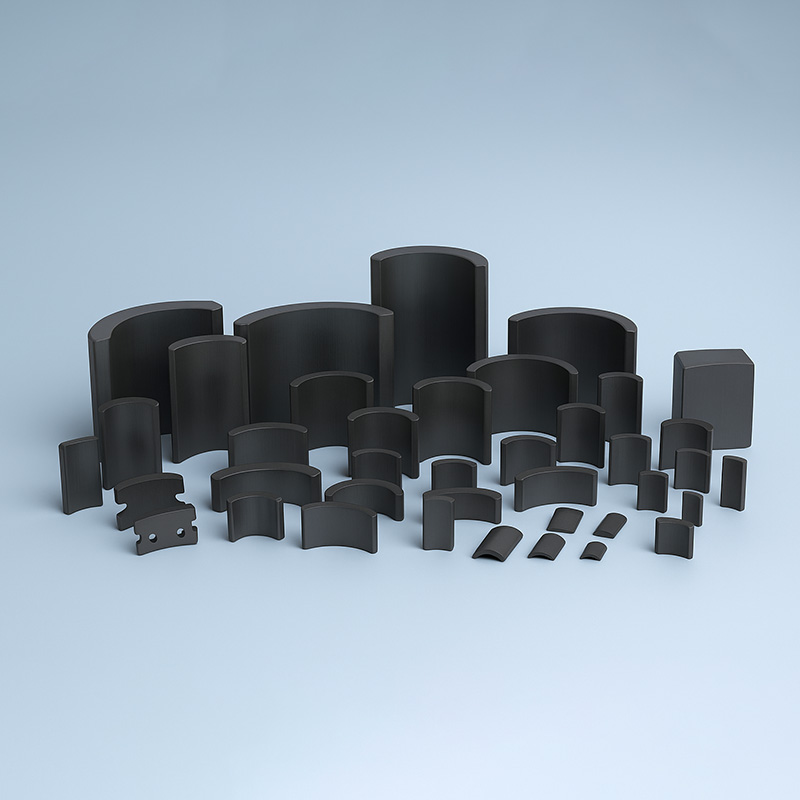
Ferrite segment magnet is the core component in small home appliance motors. Its parameters directly affect motor performance and production consistency. Batch issues like abnormal noise, low efficiency, overheating, or demagnetization are usually caused by mismatched arc, pole count, or material grade—not structural design flaws.
Based on years of experience in high-volume ferrite segment magnet production for home appliance motors, this article provides practical selection guidelines for outer-rotor small motor applications. It covers arc design, pole count, and grade selection—helping engineers and procurement teams finalize specifications quickly and minimize trial-and-error costs.
Ferrite Segment Magnet Arc and Pole Arc Coefficient
The most common pitfall in ferrite segment magnet selection is confusing physical arc angle with pole arc coefficient. The pole arc coefficient is a core parameter for electromagnetic matching in motors. It is defined as the ratio of the magnet's effective arc angle to the total pole pitch angle. For small home appliance motors, the generally applicable range is 0.7–0.8, which directly determines air gap flux density, torque ripple, and overall motor noise level.
If the pole arc coefficient is too high, the motor produces sufficient torque, but becomes prone to excessive vibration and noise. It can also cause increased flux leakage between adjacent magnets. The extra leakage reduces the effective flux available for torque production, making the motor less efficient despite the higher theoretical output.
If the pole arc coefficient is too low, flux density drops and torque weakens. The only remedy is to add more winding turns, which raises motor temperature rise and power consumption. In extreme cases, the motor may fail to reach its rated output, requiring a complete redesign of the electromagnetic circuit.
In mass production, different motor types have established parameter ranges:
Fan motors prioritize quiet operation: 0.75–0.78.
Pump motors prioritize stall resistance: 0.72–0.75.
Variable-frequency high-speed motors prioritize smooth operation: 0.70–0.73.
Magnet design must also satisfy manufacturing requirements. Standard wall thickness should be ≥3mm. Depending on arc complexity, dry pressing or wet pressing should be selected to ensure high yield and dimensional accuracy for ferrite segment magnet.
Ferrite Segment Magnet Pole Count Selection: Matching Motor Speed and Load Conditions
Small home appliance motors typically use either 2-pole or 4-pole configurations. Pole count directly determines the motor's synchronous speed, operating frequency, and load capability. Ferrite segment magnet pole configuration must align with motor design. A mismatch here can lead to poor starting torque, excessive current draw, or unstable operation across the speed range.
2-pole magnets suit high-speed fans and blowers. They use fewer magnets, are simpler to assemble, and cost less. They work well for steady high-speed operation, but have noticeable torque ripple at low speeds. This can cause audible noise in applications that operate at varying speeds.
4-pole magnets target low-speed, high-torque pumps, compressors, and other heavy-load equipment. They offer low vibration, low noise, and better stability for long-duration operation. However, production and assembly costs are higher due to the increased magnet count and more complex fixture requirements.
The practical rule: choose the simplest pole count that meets speed and torque requirements to control cost. Only adopt higher pole counts when noise and stability specifications are stringent. For most standard fan and pump applications, 2-pole is often sufficient. For premium silent products, 4-pole is worth the additional investment.
Ferrite Segment Magnet Grade Matching: Selecting the Right Grade to Avoid Failures and Cost Overruns
Ferrite segment magnet commonly uses three grades: Y30, Y30BH, and Y35. Each grade fits different operating conditions. Choosing the wrong grade can cause demagnetization failures—or performance surplus and wasted cost.
Y30 grade fits steady, low-load, normal-temperature devices like ceiling fans and ventilation fans. It offers the best cost-effectiveness for stable mass-production projects. This grade is the industry baseline for applications without demanding thermal or dynamic requirements.
Y30BH grade is the preferred choice for home appliance motors. Higher coercivity delivers better resistance to heat, stall, and demagnetization. It suits washing machine pumps, circulation pumps, and air-conditioning fan motors—applications with frequent starts and complex duty cycles. A modest material cost increase with Y30BH prevents long-term demagnetization risks that could otherwise appear after months or years of service.
Y35 grade targets high-density, compact, high-performance designs. Higher remanence fits variable-frequency fans, high-speed vacuum motors, and other space-constrained, high-power applications. These are for premium models. General-purpose equipment should not blindly adopt this grade.
Selecting the right ferrite segment magnet grade directly impacts both motor reliability and overall project cost. In many cases, the Y30BH offers the best balance of cost and performance for household applications.
Ferrite Segment Magnet Procurement: Key Points to Avoid Batch Issues
Most production failures come from unclear communication during procurement, not design errors. This section covers three critical areas that engineers and buyers often overlook.
Magnetization direction is critical. Ferrite segment magnet has its magnetic orientation fixed during pressing—it cannot be changed later. Missing or incorrect N/S marking on drawings will scrap the entire batch. The correct orientation must be clearly indicated on every drawing, with arrows showing the N→S direction.
Never rely solely on "copy the sample." Samples can deviate over time through wear, handling, or storage. Production must be based on formal 2D drawings with accurate dimensions: inner/outer radius, chord length, camber height, and tolerances. This ensures batch-to-batch consistency and eliminates guesswork in the factory.
Standard production controls flux density deviation within ±5%. For high-precision applications, ±3% sorting is achievable at extra cost. Match QC standards to project needs to balance quality and cost. Tighter control is justified only when motor performance is extremely sensitive to flux variation.
A clear, dimensioned ferrite segment magnet drawing is the most effective way to prevent batch issues. Include all critical parameters, tolerances, and quality requirements in the initial order to avoid later disputes.
Conclusion
Ferrite segment magnet selection centers on three parameters: arc, pole count, and grade. Start with pole count based on speed, then optimize pole arc coefficient for noise and load, finally select grade for temperature and duty cycle. Standardized drawings and clear specifications are the foundation for stable ferrite segment magnet production, reduced waste, and lower after-sales costs.
Kaiven Magnet has decades of experience in ferrite segment magnet manufacturing, with mature processes, full QC systems, and extensive motor application expertise. The company provides end-to-end support—from grade evaluation and custom tooling to high-volume delivery—helping customers optimize performance, control costs, and strengthen market competitiveness.